HIRAGANA · CHARACTER GUIDE
き (ki) in hiragana
Ki in hiragana is き. Written by hand it has 4 strokes; print often joins the lower part.
On this page
Handwritten and printed. Both are ki.
The full model: 4 strokes, numbered in order.
start end
This browser is not saving your study set, so it lasts for this visit.
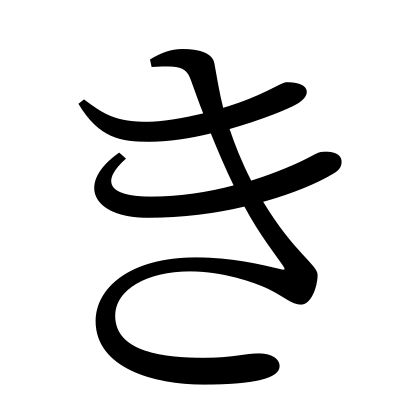
The lower curved stroke is usually separate in handwriting. Copy the four-stroke model.
Memory hook: Picture a key with two crossbars and a separate curved end. Make your own · All 46 hiragana mnemonics
More hiragana activities
WRITE IT
How to write き: stroke order
Is き 3 or 4 strokes? Four, when you write it: the lower curve is its own stroke. Many printed fonts join it to the slant above, so it can look like three.
Shape: Tall and narrow, like an upright oval.
In this model, strokes 1, 2 and 4 stop and stroke 3 ends in a hook. Japanese schools name three kinds of ending: Ending: Stop とめ, Ending: Hook はね, Ending: Sweep はらい. Textbooks and teachers differ on some.
Stroke 1Ending: Stop とめ
Starts left of the vertical center line, near the top. A short line rising gently to the right, across the center line.
Stroke 2Ending: Stop とめ
Starts a little right of where stroke 1 began, just above the horizontal center line. A second line, parallel to the first and a little longer.
Stroke 3Ending: Hook はね
Starts left of the center line, near the top. A long slant down to the right, across both lines; at the bottom, turn back and flick to the left.
Stroke 4Ending: Stop とめ
A separate stroke. Starts low on the left, under stroke 2, and curves right like a shallow bowl, ending well past the center line, a little short of where stroke 3 turns back.
One mistake to avoid: strokes 1 and 2
- Watch for
- Writing the two top lines far apart.
- Fix
- Keep the second line above the horizontal center line, as far below the first as in the model: not far apart, not squeezed together.
Stroke diagrams adapted from KanjiVG, © Ulrich Apel and contributors, CC BY-SA 3.0. License and attribution.
READ IT
Read き in print and in words.
き in handwriting and three typefaces
Handwriting model Textbook style Print, plain (gothic) Print, serif (mincho)
Many printed fonts join the lower stroke to the slant; the textbook style keeps it separate, as handwriting does. Copy the four-stroke model.
Find き inside a word.
- えきekistation. Up to the K row
- きくkikuto listen; to hear; to askUsually written 聞く.. Up to the K row
- おおきいookiibigOne of a few words that write a long o as おお; most write it おう, as in おとうさん (otousan).. Up to the K row
- きれいkireipretty; clean
“Up to the K row” marks a word written only with kana from the vowels to the K row of the chart, so you can read it if you learn the chart in order.
In everyday writing most of these words use kanji (えき is usually 駅); here they are in hiragana for reading practice.
TELL THEM APART
き or さ?
Count the bars across the top: き has two, さ has one.
A quick check
Four models, handwritten and printed: is each one き or さ? Only your first answer to each model counts. The models are pictures; each one is described in words after you answer.
This check changed in another tab. It now shows your latest answers.
Which reading matches this model?
Check finished.
A short practice with pictures of the shapes. It does not test pronunciation, listening or long-term recall.
WITH DAKUTEN
ぎ (gi): き with dakuten.
Two short marks at the upper right, called dakuten, change ki to gi. Write them last, the left one first, small and close to the upper right.
Type gi.
- かぎ kagi · key
- みぎ migi · right (side)
YOUR NEXT STEP
Practice き with さ.
A short round of き and さ, the shapes this page compares.
Practice the whole K row: か き く け こIt includes か, く, け and こ, which this page does not teach.
Learn き with its group in lesson 2 · Try it on the hiragana keyboard
Sources, artwork and review status
Teaching content on this page is a draft: a Japanese educator has not reviewed it yet. Generated pronunciation audio is available in the listening section.
Stroke models and drawings: KanjiVG, © Ulrich Apel and contributors, CC BY-SA 3.0. License and attribution.
Printed example: Hiragana letter Ki by Person or Persons Unknown, outlined from Noto Serif CJK JP, CC BY-SA 4.0; editor metadata removed, outline unchanged (source record).

Two typefaces are served from this site: Klee One and Noto Serif JP (SIL Open Font License). The gothic sample uses this device’s own font.
- Japan Foundation: MARUGOTO-NO-KOTOBA vocabulary (readings and meanings)
- Jisho.org (JMdict): readings and common spellings
- syoka-koyoblog (penmanship): き
- z-shogei calligraphy school: き
- Matsumoto Shoeido calligraphy school: き
- Matsumoto Shoeido calligraphy school: き
- 100tenkids: き in a square with center lines
- Japanese-Lesson.com: か き く け こ
- Japan Foundation’s Irodori kana materials (spelling reference)
Draft teaching content · Japanese educator review pending · Approved generated audio is available in the listening section; romaji is a reading aid, not a pronunciation guide.
minimachi · HIRAGANA CHARACTER CARD
き · ki
Ki in hiragana is き. Written by hand it has 4 strokes; print often joins the lower part.
Write it, stroke by stroke.
- Starts left of center, near the top; a short line rising gently right. — stop (とめ)
- Starts under stroke 1, above the middle; a second, slightly longer line. — stop (とめ)
- Starts at the top; slants down across both lines, then flicks left. — hook (はね)
- A separate stroke: starts low left and curves right like a shallow bowl. — stop (とめ)
Watch for: Writing the two top lines far apart. Fix: Keep the second line above the horizontal center line, as far below the first as in the model: not far apart, not squeezed together.
Trace, copy, then cover the model and write from memory.
Stroke model: KanjiVG, © Ulrich Apel and contributors · CC BY-SA 3.0 · kanjivg.tagaini.net · license: creativecommons.org/licenses/by-sa/3.0/
Printed example: Hiragana letter Ki, Person or Persons Unknown, outlined from Noto Serif CJK JP · CC BY-SA 4.0 · commons.wikimedia.org/wiki/File:Hiragana_letter_Ki.svg
Draft teaching content; Japanese educator review pending. Generated audio: see full guide.
Full guide and sources: minimachi.com/hiragana/ki/
Listen to the sounds and examples on this page
Generated speech: Google Cloud Text-to-Speech. Checked by a native Japanese speaker. Audio is available only for items with a Listen button. Listen plays at normal speed; Slow gives more listening time at the original pitch. Sound hints are drafts pending educator review.
Kana sounds
- き ki
Example words
- きく to listen; to hear; to ask
- えき station
- かぎ key
- きれい pretty; cleanSound hint (draft): Commonly sounds like きれー. Keep the kana spelling きれい; sustain each long vowel for two beats.
- おおきい big