Hiragana chart
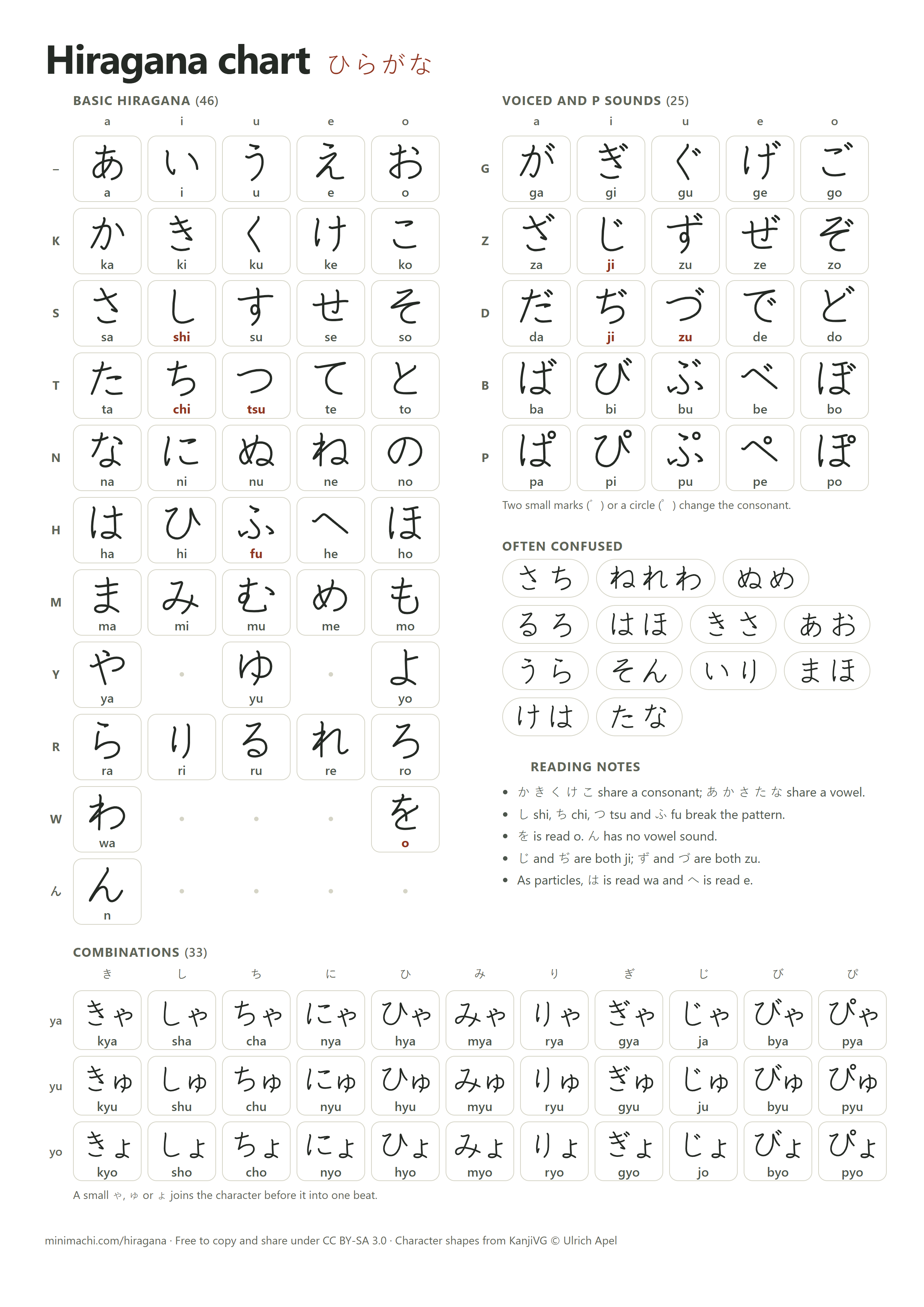
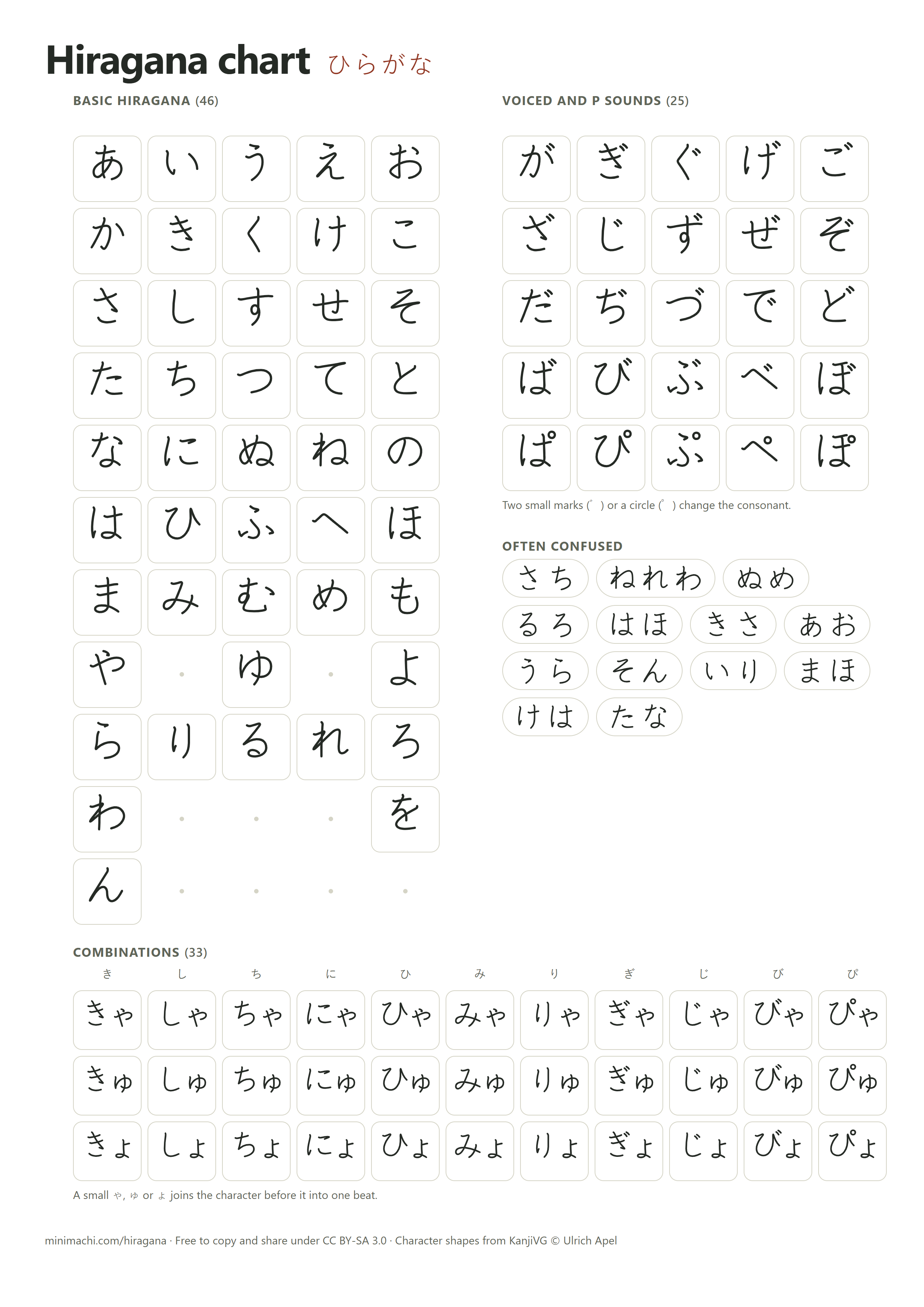
The 46 basic characters, the voiced sounds and the combinations. Choose a character to see how it is written.
Basic hiragana (46)
Voiced and p sounds (25)
Two small marks (゛) or a circle (゜) change the consonant.
Often confused
Choose a pair to select it, then practice only those characters.
Combinations (33)
A small ゃ, ゅ or ょ joins the character before it into one beat.
Printable hiragana charts (PDF and image)
Free to save and print. Choose US Letter or A4; each chart fits one page.
How to read the hiragana chart
- Each consonant group keeps its consonant while the vowel changes: か き く け こ is ka, ki, ku, ke, ko.
- Each vowel group keeps its vowel: あ か さ た な is a, ka, sa, ta, na.
- Four readings break the pattern: し is shi, ち is chi, つ is tsu and ふ is fu.
- を is read o. It marks the object of a sentence. On a keyboard you type wo.
- ん stands alone. It is the only character with no vowel sound.
- じ and ぢ are both read ji; ず and づ are both read zu. じ and ず are the usual spellings.
What is hiragana?
Hiragana is one of the three scripts used to write Japanese. Each character stands for a sound, not a meaning. The basic chart has 46 characters; two small marks and a small circle add 25 more characters, and small ゃ ゅ ょ add 33 combinations.
You do not need the whole chart before you read your first word. Start with one row, practice it, then read words made from it.
Questions about the chart
How many hiragana are there?
There are 46 basic hiragana. The voiced marks and the small circle give 25 marked forms, and this chart lists 33 combinations written with a small ゃ, ゅ or ょ.
What order is the chart in?
The chart follows gojūon order: the five vowels a, i, u, e, o, then the same vowels after k, s, t, n, h, m, y, r and w, with ん last. Japanese dictionaries use the same order.
Why are some boxes empty?
The grid has 50 places and modern Japanese fills 45 of them; ん makes 46. The sounds yi, ye and wu have no character, and the old characters ゐ (wi) and ゑ (we) left standard spelling in 1946.
Which way is the chart read?
In the Rows layout each row runs left to right. Japanese textbooks often print the chart the traditional way, in columns read from top to bottom, starting at the right. Use the Japanese order layout to see that version.
Should I learn hiragana or katakana first?
Start with hiragana for this beginner path; learn useful katakana alongside it when you need it. See why hiragana comes first, and how katakana differs, or see both scripts in the hiragana and katakana chart.
Use the chart
Teaching content is a draft awaiting review by a Japanese educator. Generated audio is available in the listening section. Optional Textbook and Mincho typefaces: Klee One and Noto Serif JP, SIL Open Font License. Character shapes are drawn from KanjiVG, © Ulrich Apel and contributors, under CC BY-SA 3.0.