HIRAGANA · CHARACTER GUIDE
そ (so) in hiragana
So in hiragana is そ. It has two handwritten forms, and both are correct.
On this page
Two ways to write そ. Both are correct.
The full model: one stroke.
start end
This browser is not saving your study set, so it lasts for this visit.
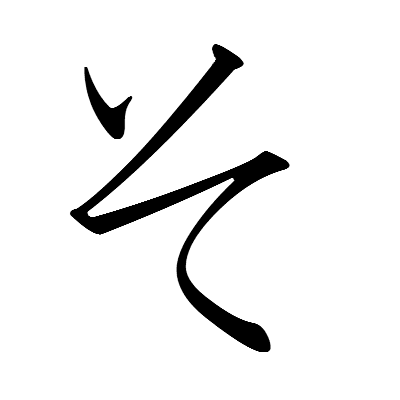
Every Grade 1 textbook has shown the connected form since 1992 (most switched decades earlier), and many adults still write the two-stroke form. The animation, the card and the writing sheets use the connected model.
Memory hook: Picture a thread zigzagging at the top and bending into a curve below. Make your own · All 46 hiragana mnemonics
More hiragana activities
WRITE IT
How to write そ: stroke order
One stroke or two? This guide teaches the connected form in one stroke, as Japanese school textbooks do. The two-stroke form is also correct.
Shape: A tall rectangle. The short top line is centered on the vertical center line.
In this model, the stroke stops. Japanese schools name three kinds of ending: Ending: Stop とめ, Ending: Hook はね, Ending: Sweep はらい. Textbooks and teachers differ on some.
One strokeEnding: Stop とめ
One continuous stroke. Start a little left of the vertical center line, near the top, and write a short line right across it; turn sharply down-left, then a long line right across the middle; turn sharply back into the lower curve, which bulges a little left of the vertical center line, and finish toward the right.
One mistake to avoid
- Watch for
- Rounding a turn, or turning early, so the next line starts beside the one you have just written.
- Fix
- Make each turn on the line you have just drawn, going back over it a little, with no gap.
Stroke diagrams adapted from KanjiVG, © Ulrich Apel and contributors, CC BY-SA 3.0. License and attribution.
READ IT
Read そ in print and in words.
そ in handwriting and three typefaces
Handwriting model Textbook style Print, plain (gothic) Print, serif (mincho)
Printed そ can look different from both handwritten forms. Copy the connected handwriting model.
Find そ inside a word.
- そこsokothere. Up to the S row
- おそいosoilate; slow. Up to the S row
- そらsorasky
- そとsotooutside
“Up to the S row” marks a word written only with kana from the vowels to the S row of the chart, so you can read it if you learn the chart in order.
そこ can refer to a place near the listener or a place already mentioned. In everyday writing そら is usually 空 and そと 外; here they are in hiragana for reading practice.
TELL THEM APART
そ or ん?
Look at the top. そ always starts with a short line: in the one-stroke form it turns sharply into a zigzag; in the two-stroke form it is a separate mark at the upper left. ん has no short line: it starts with one long diagonal. (Do not confuse this pair with the katakana ソ (so) and ン (n), a famous look-alike pair.)
A quick check
Four models: both forms of そ, and ん, handwritten and printed. Only your first answer to each model counts. The models are pictures; each one is described in words after you answer.
This check changed in another tab. It now shows your latest answers.
Which reading matches this model?
Check finished.
A short practice with pictures of the shapes. It does not test pronunciation, listening or long-term recall.
WITH DAKUTEN
ぞ (zo): そ with dakuten.
Add dakuten, the two small marks at the upper right, to change そ (so) into ぞ (zo); write them last, the left one first. The separate upper-left mark in the two-stroke form of そ is part of the character, not dakuten.
Type zo.
- かぞく kazoku · family
- どうぞ douzo · please, go ahead; here you are どう is said as a long o: dō.
YOUR NEXT STEP
Practice そ with ん.
A short round of そ and ん, the shapes this page compares.
Practice the whole S row: さ し す せ そIt includes さ, し, す and せ, which this page does not teach.
Learn そ with its group in lesson 3 · Try it on the hiragana keyboard
Sources, artwork and review status
Teaching content on this page is a draft: a Japanese educator has not reviewed it yet. Generated pronunciation audio is available in the listening section.
Stroke models and drawings: KanjiVG, © Ulrich Apel and contributors, CC BY-SA 3.0. License and attribution.
Two-stroke picture: Wikimedia Commons (千思万考), released to the public domain; later color cleanup by Hlkegs. Shown with its white background made transparent; the ink is unchanged (source record).

Two typefaces are served from this site: Klee One and Noto Serif JP (SIL Open Font License). The gothic sample uses this device’s own font.
- Nara University of Education: one- and two-stroke forms
- Penmanship teacher: two ways to write そ
- Japan Foundation: Starter vocabulary
- Japan Foundation: Activities vocabulary
- MEXT: hiragana reading chart
- Wikimedia Commons: separated-top illustration
- Japan Foundation: MARUGOTO-NO-KOTOBA vocabulary (readings and meanings)
- Jisho.org (JMdict): readings and common spellings
- syoka-koyoblog (penmanship): そ
- z-shogei calligraphy school: そ
- Matsumoto Shoeido calligraphy school: そ
- Nara University of Education: textbook handwriting models compared
- Japan Foundation’s Irodori kana materials (spelling reference)
Draft teaching content · Japanese educator review pending · Approved generated audio is available in the listening section; romaji is a reading aid, not a pronunciation guide.
minimachi · HIRAGANA CHARACTER CARD
そ · so
So in hiragana is そ. It has two handwritten forms, and both are correct.
Write it, stroke by stroke.
- Short line, turn down-left, long line right, then the lower curve. — stop (とめ)
Watch for: Rounding a turn, or turning early, so the next line starts beside the one you have just written. Fix: Make each turn on the line you have just drawn, going back over it a little, with no gap.
Trace, copy, then cover the model and write from memory.
Stroke model: KanjiVG, © Ulrich Apel and contributors · CC BY-SA 3.0 · kanjivg.tagaini.net · license: creativecommons.org/licenses/by-sa/3.0/
Two-stroke picture: 千思万考, Wikimedia Commons, public domain; Hlkegs color cleanup · commons.wikimedia.org/wiki/File:Hiragana_so.png
Draft teaching content; Japanese educator review pending. Generated audio: see full guide.
Full guide and sources: minimachi.com/hiragana/so/
Listen to the sounds and examples on this page
Generated speech: Google Cloud Text-to-Speech. Checked by a native Japanese speaker. Audio is available only for items with a Listen button. Listen plays at normal speed; Slow gives more listening time at the original pitch. Sound hints are drafts pending educator review.
Kana sounds
- そ so
Example words
- そら sky
- おそい late; slow
- そこ there
- そと outside