Hiragana and katakana chart
The 46 basic kana pairs in hiragana and katakana, with romaji readings. Choose a pair to compare its shapes and strokes, or keep a printable copy.
Basic hiragana and katakana (46)
Voiced and p sounds (25)
Combinations (33)
Small ゃ ゅ ょ joins the kana before it into one beat. Read the rules.
Two short marks or a circle change the consonant. Dakuten and handakuten.
Your one-off set
Look-alikes
Across scripts: similar shapes, not always identical. Compare the seven pairs.
Often confused in katakana:
Select a group, then practice it in either script.
Printable hiragana and katakana chart (PDF and PNG)
Both scripts, 46 basic pairs, 25 marked pairs and 33 combinations. PDFs fit one landscape sheet. Kana shapes: KanjiVG, CC BY-SA 3.0.
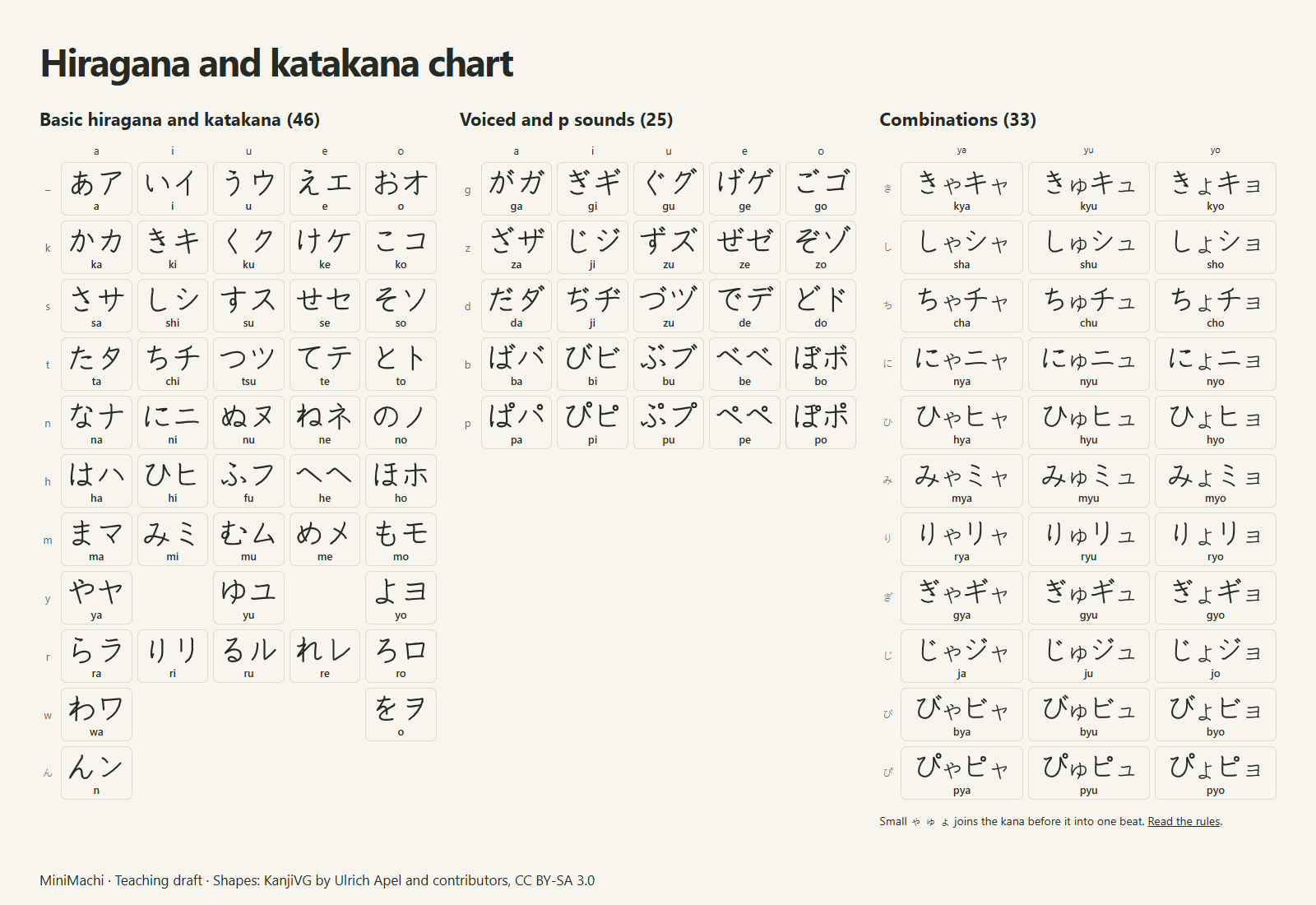
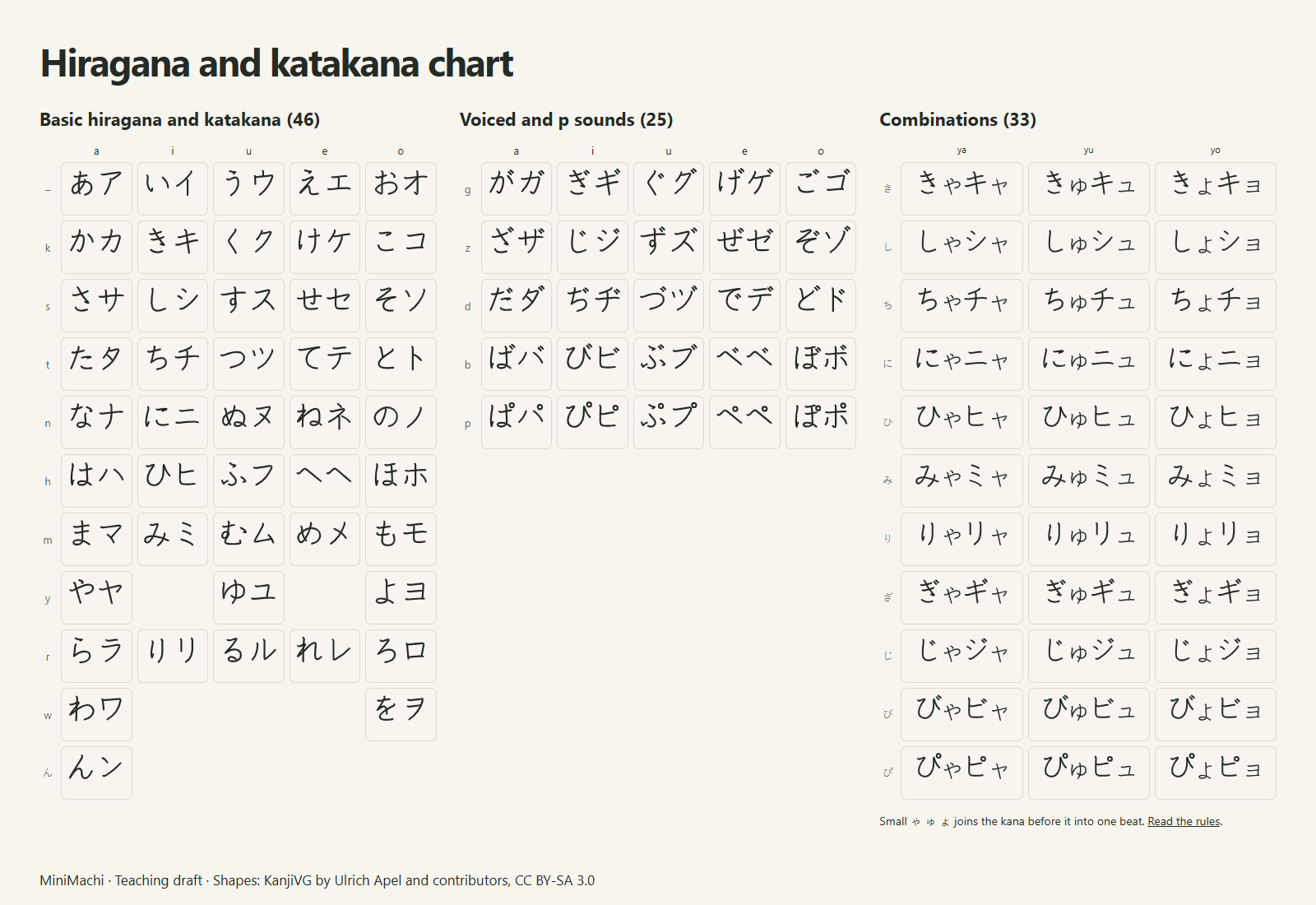
How to read the chart
The basic pairs have the same readings. し/シ is shi, ち/チ is chi, つ/ツ is tsu and ふ/フ is fu. を/ヲ is usually read o; type wo to enter it. ぢ/ヂ is ji and づ/ヅ is zu in standard Japanese; keyboard spellings are di and du. The particle is normally written を in modern text; ヲ is uncommon.
The row and column headings combine: k + a gives ka. Blank cells have no modern basic kana. ん / ン represents a nasal sound with no following vowel.
Questions about the hiragana and katakana chart
Is this the Japanese alphabet?
These are kana. A character usually represents a vowel or a consonant-plus-vowel sound; kana do not match English letters one by one.
Is there a chart with kanji too?
Kanji are a much larger set of characters for words and word parts. This page pairs kana sounds. The writing-systems page explains how kanji joins them.
What else appears in katakana words?
Katakana commonly uses ー for a long vowel, as in コーヒー. Small vowels make spellings such as ファ (fa), ティ (ti) and ウィ (wi), often in loanwords. Hiragana also has small kana; they are not exclusive to katakana.
Use the chart
Teaching content is draft; educator review pending. Generated audio is available in the listening section. Kana shapes: KanjiVG, Ulrich Apel and contributors, CC BY-SA 3.0.
Listen to the sounds and examples on this page
Generated speech: Google Cloud Text-to-Speech. Checked by a native Japanese speaker. Audio is available only for items with a Listen button. Listen plays at normal speed; Slow gives more listening time at the original pitch. Sound hints are drafts pending educator review.
Kana sounds
- ひ hi
- も mo
- す su
- ぢ ji
- そ so
- か ka
- い i
- よ yo
- な na
- ら ra
- む mu
- て te
- ば ba
- ぴ pi
- の no
- え e
- め me
- だ da
- つ tsu
- き ki
- せ se
- び bi
- ど do
- が ga
- ま ma
- げ ge
- ゆ yu
- た ta
- じ ji
- ず zu
- れ re
- ぼ bo
- ぶ bu
- ろ ro
- ち chi
- り ri
- う u
- ふ fu
- ぞ zo
- へ he
- と to
- ぱ pa
- ぎ gi
- お o
- く ku
- ん n
- ほ ho
- べ be
- ぽ po
- ね ne
- け ke
- ぷ pu
- ぐ gu
- ぜ ze
- る ru
- み mi
- し shi
- ぺ pe
- あ a
- を o
- わ wa
- ご go
- は ha
- に ni
- ざ za
- づ zu
- こ ko
- さ sa
- ぬ nu
- や ya
- で de
Joined sounds
- にゅ nyu
- しゃ sha
- きゅ kyu
- ぴょ pyo
- しょ sho
- みょ myo
- しゅ shu
- ぎゅ gyu
- じゅ ju
- ひゃ hya
- ぴゅ pyu
- びゃ bya
- りゅ ryu
- きゃ kya
- りょ ryo
- じゃ ja
- みゅ myu
- じょ jo
- みゃ mya
- りゃ rya
- ひょ hyo
- にゃ nya
- ちょ cho
- ちゅ chu
- きょ kyo
- びゅ byu
- ぎゃ gya
- にょ nyo
- びょ byo
- ひゅ hyu
- ぴゃ pya
- ちゃ cha
- ぎょ gyo