Hiragana writing practice
Watch, trace, copy, then write from memory. Compare stroke direction, order and count; the check does not grade neatness.
Approximate comparison to this model. It does not judge shape quality, pen pressure or stroke endings. Progress stays in this browser; ink is cleared on reload.
Numbered models to copy
あ · a
Character guideい · i
Character guideう · u
Character guideえ · e
Character guideお · o
Character guideHow to write hiragana
Follow the numbers and direction
Strokes generally run top to bottom and left to right. Follow the numbered model when its sequence differs. A corner can still belong to one stroke.
One stroke is one pen-down
Lift between numbered strokes. The lower curve of handwritten き is a separate stroke. See the き guide.
How a stroke ends: stop, hook and sweep
Stop (とめ) finishes firmly; hook (はね) turns briefly at the end; sweep (はらい) tapers away. The model tracks the pen’s route, not brush pressure.
Fit the character in a square
Use the center lines to compare placement and balance. Compare your ink with the model; a stroke match is not a judgment of neatness.
Small kana in horizontal writing
Write small ゃ ゅ ょ っ smaller, low and toward the left in their square. See how the small forms work in combinations.
A routine for screen or paper
Watch the sequence, trace its route, copy with the model beside you, then hide it and write from memory. Return to the model when unsure.
Hiragana handwriting vs print
Left: this device’s print. Right: the numbered KanjiVG pen model. Printed letters can join or reshape strokes; copy the handwriting model when practicing with a pen.
Save the handwriting and print comparison image
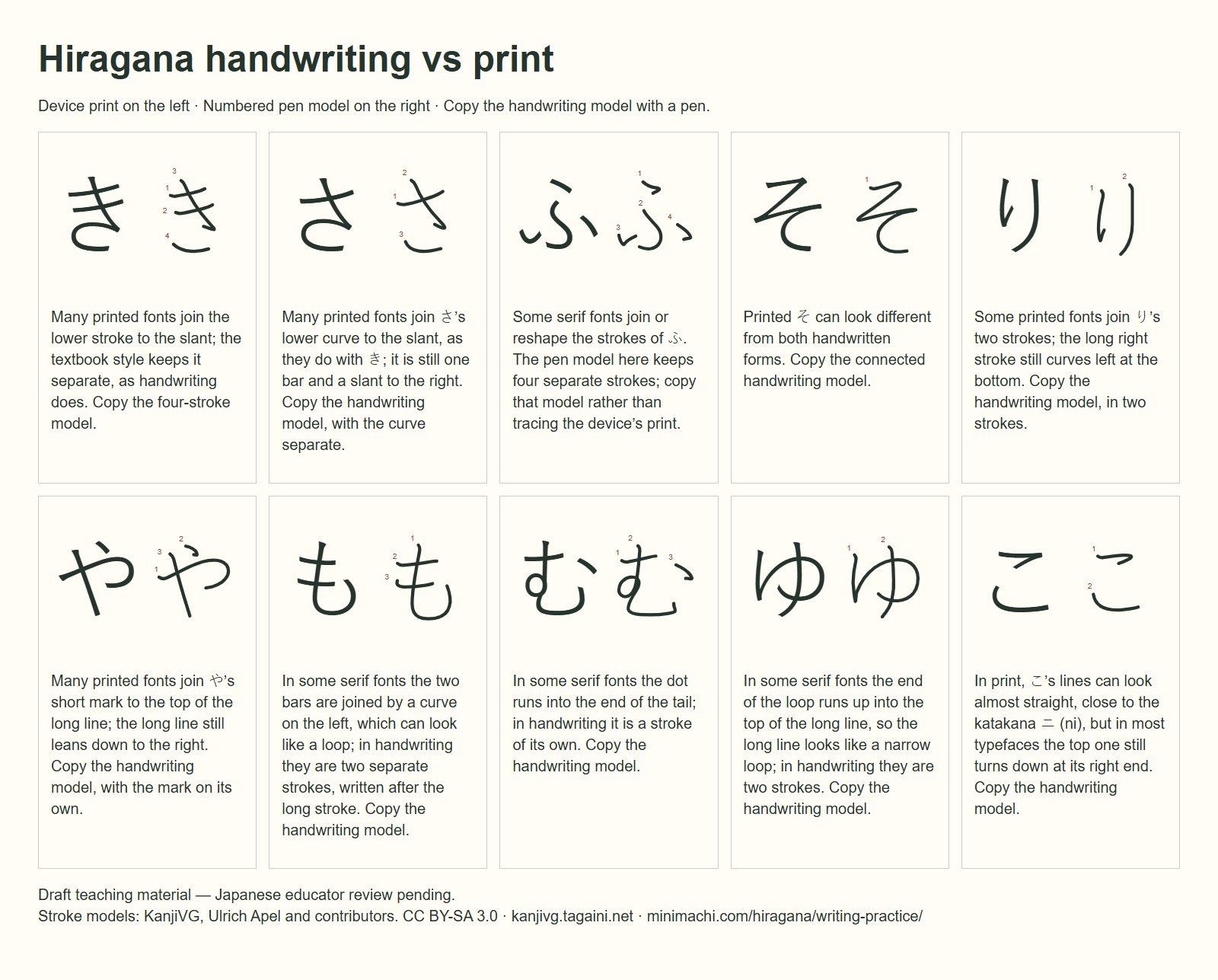
Many printed fonts join the lower stroke to the slant; the textbook style keeps it separate, as handwriting does. Copy the four-stroke model.
Many printed fonts join さ’s lower curve to the slant, as they do with き; it is still one bar and a slant to the right. Copy the handwriting model, with the curve separate.
Some serif fonts join or reshape the strokes of ふ. The pen model here keeps four separate strokes; copy that model rather than tracing the device’s print.
Printed そ can look different from both handwritten forms. Copy the connected handwriting model.
Some printed fonts join り’s two strokes; the long right stroke still curves left at the bottom. Copy the handwriting model, in two strokes.
Many printed fonts join や’s short mark to the top of the long line; the long line still leans down to the right. Copy the handwriting model, with the mark on its own.
In some serif fonts the two bars are joined by a curve on the left, which can look like a loop; in handwriting they are two separate strokes, written after the long stroke. Copy the handwriting model.
In some serif fonts the dot runs into the end of the tail; in handwriting it is a stroke of its own. Copy the handwriting model.
In some serif fonts the end of the loop runs up into the top of the long line, so the long line looks like a narrow loop; in handwriting they are two strokes. Copy the handwriting model.
In print, こ’s lines can look almost straight, close to the katakana ニ (ni), but in most typefaces the top one still turns down at its right end. Copy the handwriting model.
The two-stroke form of そ is a recognized alternative. The online matcher only has the displayed KanjiVG form, so it asks you to compare other forms yourself.
Handwriting examples: whole words
ねこ · neko · cat. Leave each kana its own square and keep the strokes within each character in order.
Practice on paper
Printable writing practice sheets provide trace, copy and recall boxes in US Letter and A4. A keyboard user can watch or step through the model here, write on paper, then record that action without an automatic stroke comparison.
Questions about writing practice
Does the check grade my handwriting?
No. It roughly compares the displayed model’s stroke direction, order and count. An accepted trace can still differ in shape or proportion; a valid alternative may need manual comparison.
Can I write with a finger, mouse or stylus?
Draw with a finger, mouse or stylus. Drawing support may vary by device and browser; use the printable sheets if drawing does not work for you. Undo removes one stroke; Clear removes all ink.
Is hiragana written left to right?
Horizontal text runs left to right. Vertical columns run top to bottom, ordered right to left. Compare the Japanese writing systems.
Do I need a brush?
A pen is enough for this practice. These models and checks do not teach brush pressure.
About these models
Teaching content is a draft; Japanese educator review is pending. Generated audio is available in the listening section. Kana models: KanjiVG, Ulrich Apel and contributors, CC BY-SA 3.0. Written checks do not assess pronunciation or listening.
Listen to the sounds and examples on this page
Generated speech: Google Cloud Text-to-Speech. Checked by a native Japanese speaker. Audio is available only for items with a Listen button. Listen plays at normal speed; Slow gives more listening time at the original pitch. Sound hints are drafts pending educator review.
Kana sounds
- ひ hi
- も mo
- す su
- ぢ ji
- そ so
- か ka
- い i
- よ yo
- な na
- ら ra
- む mu
- て te
- ば ba
- ぴ pi
- の no
- え e
- め me
- だ da
- つ tsu
- き ki
- せ se
- び bi
- ど do
- が ga
- ま ma
- げ ge
- ゆ yu
- た ta
- じ ji
- ず zu
- れ re
- ぼ bo
- ぶ bu
- ろ ro
- ち chi
- り ri
- う u
- ふ fu
- ぞ zo
- へ he
- と to
- ぱ pa
- ぎ gi
- お o
- く ku
- ん n
- ほ ho
- べ be
- ぽ po
- ね ne
- け ke
- ぷ pu
- ぐ gu
- ぜ ze
- る ru
- み mi
- し shi
- ぺ pe
- あ a
- を o
- わ wa
- ご go
- は ha
- に ni
- ざ za
- づ zu
- こ ko
- さ sa
- ぬ nu
- や ya
- で de